
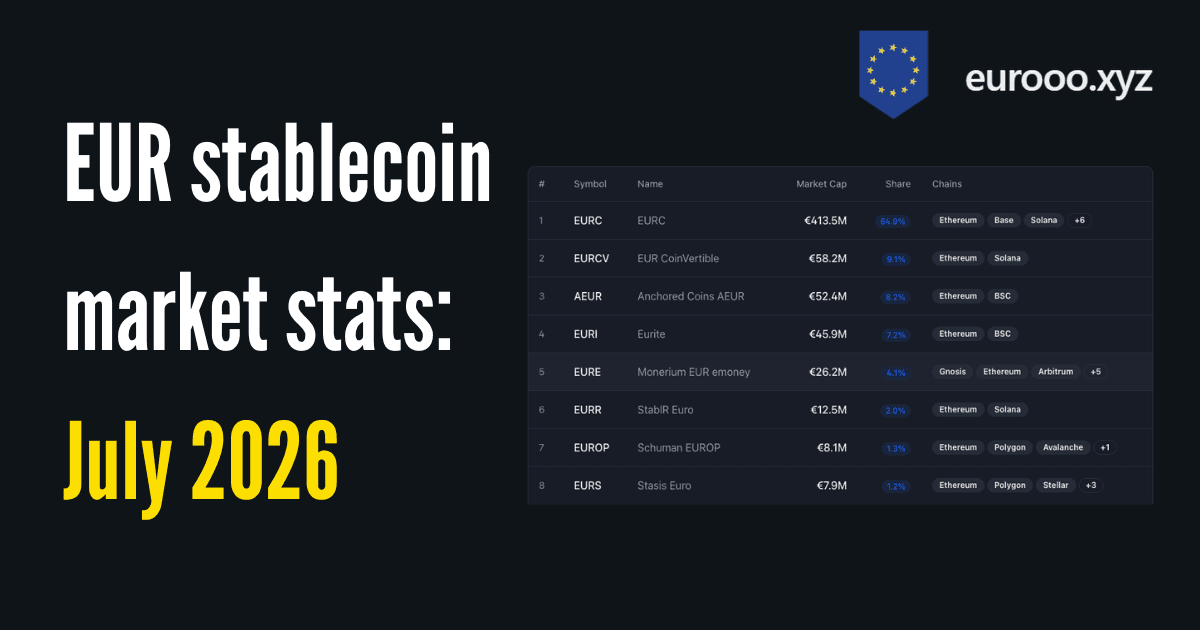
EUR Stablecoin Market Overview — July 2026
July 1, 2026 is not just a reporting date. It is the day the EU's MiCA transitional period ended in full — the regulatory deadline that has structured the entire European crypto industry for the past 18 months. Every crypto firm operating in the EU without full CASP authorisation is now in breach of EU law. Every non-compliant stablecoin is now delisted from licensed platforms.
As of July 1, 2026, the total circulating supply of EUR-denominated stablecoins stands at $655 million, per DefiLlama — roughly flat from June, ending four consecutive months of headline contraction. There are currently 18 EUR stablecoins tracked across 26 blockchains. (AEUR's exit from active supply last month reduces the count by one.)
The supply number tells only part of the story. EUR stablecoin transaction volume has risen 1,200% since early 2025, reflecting a market where capital is consolidating into fewer, compliant issuers and turning over far more actively. The market is not growing in headline supply yet — but it is functioning at a fundamentally different level of activity than it was a year ago.
Top 10 EUR Stablecoins by Market Cap
Here is the full ranking of the ten largest Euro stablecoins by circulating supply as of July 1, 2026.
1. EURC (Circle) — ~€380M (61.1% market share) EURC holds first place with a circulating supply of approximately 380 million tokens, commanding its highest market share since the market peak in early 2026. With non-compliant alternatives removed from licensed EU platforms, EURC is now listed on all 14 licensed EU exchanges and is the default euro stablecoin for retail and institutional users across the bloc. The Wirex/Stellar Visa settlement integration (7 million+ users) and presence across Ethereum, Base, Solana, Avalanche, and additional chains anchor its distribution lead.
2. EURCV / EUR CoinVertible (SG Forge) — ~€90M (14.5%) EURCV continues its run of consecutive monthly supply growth — now in its fifth month — and remains the clearest institutional challenger to EURC. SG Forge's multi-chain presence (Ethereum, Solana, XRP Ledger, Stellar), Wintermute market-making, and Morpho DeFi integration have built liquidity depth that institutional buyers can rely on. A bank-issued, fully reserved, MiCA-compliant euro stablecoin from one of Europe's largest banks is exactly the product the post-July 1 market was built for.
3. EURI / Eurite — ~€55M (8.9%) EURI holds third place for the fourth consecutive month at approximately €55M. Available on Ethereum and BSC, EURI is among the quieter success stories of MiCA compliance — consistently growing without major news flow, simply by being compliant and available as alternatives exit.
4. EURE / Monerium EUR emoney — ~€28M (4.5%) Monerium's EURE holds fourth at approximately €28M. EURE remains the most widely deployed EUR stablecoin by blockchain count, available on Gnosis, Ethereum, Arbitrum, Polygon, and additional chains.
5. EURR / StablR Euro — ~€12M (1.9%) EURR holds fifth at approximately €12M on Ethereum and Solana.
6. EURS / Stasis Euro — ~€8M (1.3%) EURS holds steady at approximately €8M across Ethereum, Polygon, Stellar, Algorand, and additional chains.
7. EUROP / Schuman EUROP — ~€8M (1.3%) Schuman's EUROP remains at approximately €8M on Ethereum, Plasma, Avalanche, and Polygon.
8. EURm / Mento Euro — ~€4M (0.6%) EURm holds steady at approximately €4M on Celo, Solana, and Polygon.
9. EURAU / AllUnity EUR — ~€4M (0.6%) EURAU is quietly growing. The Deutsche Börse Group partnership — bringing EURAU into Clearstream's institutional custody infrastructure — is beginning to translate into supply growth. AllUnity remains small, but its backing from DWS, Flow Traders, Galaxy, and Deutsche Börse gives it a distribution pathway most smaller EUR stablecoins lack.
10. EURA (formerly agEUR / Angle Protocol) — ~€2M (0.3%) — Winding Down EURA's governance community voted in June to formally wind down operations. EURA and USDA holders can redeem tokens 1:1 for EURC and USDC on Ethereum until March 1, 2027. After that date, Angle Protocol will cease active operations and distribute remaining reserves pro-rata. This is an orderly exit — not a collapse — but it marks the end of one of the original EUR DeFi stablecoin projects.
Other EUR Stablecoins (Ranked 11–14)
11. VEUR / VNX EURO — ~€2M (0.2%) Available on Solana, Avalanche, Base, and additional chains.
12. PAR / Parallel — ~€1.2M (0.1%) Available on Ethereum, Polygon, and Fantom.
13. EURT / Euro Tether — ~€250K (0.0%) Tether's euro stablecoin continues its wind-down. With USDT not MiCA-compliant, Tether has effectively exited the European stablecoin market entirely.
14. EUROe / EUROe Stablecoin — ~€100K (0.0%) Available on Solana, Polygon, Ethereum, Arbitrum, and additional chains.
EUR Stablecoin Market Share Distribution
Market share in July 2026:
- EURC — 61%
- EURCV — 15%
- EURI — 9%
- EURE — 5%
- EURR — 2%
- EURS — 1%
- EUROP — 1%
- All others — 6%
The top three coins — EURC, EURCV, and EURI — now account for 85% of total EUR stablecoin supply. EURC's share at 61% is its highest reading since the market peaked in early 2026. The consolidation trend that has run throughout 2026 is now complete: the market is concentrated in MiCA-compliant issuers, and everything else is in single-digit territory or exiting.
Blockchain Distribution of EUR Stablecoins
EUR stablecoins remain deployed across 26 blockchains. The three largest chains by EUR stablecoin supply:
- Ethereum — ~70% of total EUR stablecoin supply
- Solana — ~12%
- Base — ~9%
Ethereum's share has edged down slightly as EURCV's XRP Ledger and Stellar activity grows and Solana gains ground. Base continues to grow through Coinbase's native EURC integration.
What Happened This Month
July 1: The MiCA CASP deadline arrived — and the market restructured. This is the day that ends the EU's crypto transitional period with no extensions and no exceptions. As of the deadline, approximately 210 firms hold full CASP authorisation — out of an estimated 1,200+ businesses that previously operated under national VASP registrations. That is a conversion rate of roughly 17%. The other 83% are now operating in breach of EU law, in wind-down, or have quietly exited. Only 14 centralised exchanges hold full trading licences: Coinbase (Luxembourg), Kraken (Ireland), eToro, Bitvavo, Bybit EU, OKX, Bitstamp, Crypto.com, Bitpanda, Revolut Digital Assets, Gate.io EU, One Trading Exchange, Bullish Exchange, and WhiteBIT EU. Germany leads all EU member states with 56 authorisations, followed by the Netherlands (26), France (21), Malta (15), Cyprus (13), and Ireland (12).
Binance exited the EU on July 1. The world's largest crypto exchange suspended all services for EU residents on July 1 after withdrawing its Greek CASP application on June 24. Reports indicate the Greek regulator was preparing to reject Binance's application — with the rejection expected to turn on co-founder Changpeng Zhao's ability to pass MiCA's "fit and proper" test for owners and managers, given his prior US criminal proceedings. User funds remain safe and withdrawable. Binance has stated it intends to apply for a licence in France and return to the EU market. This is a suspension, not a permanent exit — but the world's largest exchange losing EU access on day one of the post-transitional era is the clearest possible signal of how seriously regulators are taking the new regime.
USDT is now fully removed from licensed EU platforms. Tether never applied for MiCA's Electronic Money Token authorisation. Tether CEO Paolo Ardoino has stated that MiCA's requirement to hold 60% of reserves in European bank deposits is fundamentally incompatible with Tether's business model. With the transitional period over, all 14 licensed EU exchanges have delisted USDT spot pairs for EEA users. USDT is not illegal to hold — EU users can still self-custody it — but it cannot be traded on any regulated European venue. EUR stablecoin transaction volume has risen 1,200% since early 2025, in part because the only compliant stablecoins left on EU exchanges are USDC and EUR-denominated alternatives.
EURA (Angle Protocol) voted to wind down. One of the original euro DeFi stablecoin projects, Angle Protocol, announced a community-approved wind-down in June. EURA and USDA holders can redeem 1:1 for EURC or USDC on Ethereum until March 1, 2027. After that, remaining reserves will be distributed pro-rata. Angle co-founder Pablo Veyrat cited the ongoing operational overhead of maintaining an idle protocol for a diminishing user base. EURA's decline from its early peak — when it briefly held the largest EUR stablecoin position — to wind-down traces the full arc of unregulated euro DeFi. MiCA changed the game; Angle, which never obtained an EMT licence, could not adapt in time.
Key Takeaways for July 2026
- July 1 restructured the European crypto market in a single day. With 83% of firms unlicensed, the market has effectively bifurcated between 210 authorised operators and everyone else. The regulatory landscape is no longer evolving — it has arrived.
- The consecutive monthly decline has ended. At $655M, the market is roughly flat from June, ending four straight months of supply contraction. Whether this stabilisation turns into growth will depend on how USDT liquidity migrates and whether Qivalis launches on schedule in H2.
- Binance's exit is the biggest single story. The world's largest exchange losing EU access on day one is a defining moment for European crypto. Its departure hands volume and users to the 14 licensed competitors — and makes EURC and EURCV the primary beneficiaries of any USDT-to-EUR migration.
- EURC at 61% share is the MiCA dividend in numbers. A year ago EURC held around 60–65% of a smaller market. Today it holds 61% of a market that has consolidated around compliant issuers. The share is similar but the competitive quality of what's left in the market is entirely different.
- The Qivalis clock is ticking. 37 banks, a DNB licence application in progress, and an H2 2026 launch timeline now just months away. If Qivalis launches on schedule into a post-Binance, post-USDT European market, it enters a landscape structurally more ready for a bank-issued euro stablecoin than at any previous point.
Frequently Asked Questions
What is the total EUR stablecoin market cap in July 2026? $655 million as of July 1, 2026, per DefiLlama — roughly flat from June, ending four consecutive months of decline. EUR stablecoin transaction volume has grown 1,200% since early 2025, reflecting a market that is consolidating and turning over capital more actively even as headline supply stabilises.
What happened to Binance on July 1, 2026? Binance suspended all EU services on July 1 after withdrawing its Greek CASP licence application on June 24. The rejection was reportedly linked to co-founder Changpeng Zhao failing MiCA's "fit and proper" test. User funds remain safe and withdrawable. Binance intends to re-apply for a licence in France and return to the EU market.
How many companies are MiCA-authorised? As of July 1, 2026, approximately 210 firms hold full CASP authorisation across the EU — out of an estimated 1,200+ that previously operated under national VASP registrations. Only 14 centralised exchanges hold full trading licences. Germany leads with 56 total authorisations, followed by the Netherlands (26) and France (21).
Is USDT banned in Europe? USDT is not banned for individuals to hold, but it can no longer be offered, listed, or traded on any MiCA-licensed exchange for EEA users. Tether never applied for MiCA's EMT authorisation, and its CEO has stated the EU reserve requirements are incompatible with Tether's business model.
What happened to EURA / Angle Protocol? Angle Protocol's token holders voted to wind down EURA and USDA. Holders can redeem both tokens 1:1 for EURC or USDC on Ethereum until March 1, 2027. After that date, the protocol will cease active operations and distribute remaining reserves pro-rata to remaining holders.
What is Qivalis and when does it launch? Qivalis is a joint venture of 37 European banks — including ABN AMRO, Rabobank, Nordea, Intesa Sanpaolo, and 5 Spanish institutions — building a bank-issued, MiCA-compliant euro stablecoin. Qivalis has applied to De Nederlandsche Bank for an EMI licence and is targeting an H2 2026 launch. If it launches on schedule, it enters a post-Binance, post-USDT European market structurally more ready for a regulated, bank-backed euro stablecoin than at any previous point.
Data sourced from DefiLlama Stablecoins, CoinGecko, CoinMarketCap, and ESMA. For live EUR stablecoin data and DeFi yields, visit eurooo.xyz.